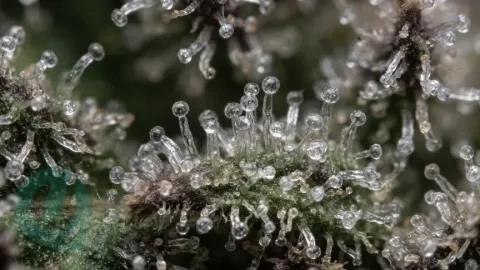
Look closely at a hemp flower and you will see a fine, sparkling coat, as if it had been dusted with sugar. This "frost" is made of trichomes: tiny glandular hairs in which the plant produces almost all of its cannabinoids, such as CBD, CBG or THC, along with the terpenes that give it its aroma. Learning to read trichomes tells you how ripe a flower was when it was harvested, how carefully it was handled, and what to look for when comparing CBD flowers.
The key points. Trichomes are the small resin glands on the flowers and leaves of the cannabis plant. The large stalked trichomes on the calyxes are the main source of cannabinoids and terpenes. Their colour changes as they mature, from clear to milky to amber, which gives a guide to harvest time. A dense layer of intact, milky trichomes is a good sign of quality. Only a lab analysis, however, shows the actual CBD and THC content.
Cannabis and hemp trichomes: what they are, how they are built and why they decide the quality of a flower
The word trichome comes from the Greek for "hair". Many plants have them, such as tomatoes, mint and lavender. In Cannabis sativa, whether industrial hemp or THC-rich varieties, they are especially well developed. There are two main groups:
- Non-glandular trichomes: fine, pointed hairs on leaves and stems. They produce no cannabinoids and mainly serve as mechanical protection.
- Glandular trichomes: small glands with a head in which cannabinoids, terpenes and flavonoids are made. These are the ones people mean when they talk about cannabis trichomes.
A glandular trichome consists of a head and, depending on the type, a stalk. At the base of the head sits a disc of secretory cells. These cells produce the resin and release it into a cavity under the outer skin (the cuticle). That is where the cannabinoids collect in their acid form, CBDA, CBGA or THCA, together with the terpenes. This explains why the heads are so fragile: they are essentially tiny resin bubbles.
Why does the plant produce trichomes?
For the plant, trichomes are a shield. The sticky resin and strongly scented terpenes keep insects and grazing animals away, the hairs reduce water loss, and the layer protects delicate flower tissue from strong sunlight. It makes sense that most trichomes are concentrated on the female flowers: that is where the seeds form, the part the plant most needs to protect.
The three types of glandular trichomes
Under a microscope, three types of glandular trichomes can be told apart on cannabis:
| Type | Appearance | Where found | Importance |
|---|---|---|---|
| Bulbous | Very small, often only a few cells | All over the plant | Low, hardly any resin |
| Capitate-sessile | Head sitting directly on the surface, no visible stalk, usually 8 secretory cells | Mainly on leaves | Medium |
| Capitate-stalked | Mushroom-shaped: a large head on a stalk, 12 to 16 secretory cells | On calyxes, bracts and sugar leaves | Main source of cannabinoids and terpenes |
Stalked trichomes are the stars of the plant. According to a study in the Journal of Cannabis Research (2023), their heads measure roughly 40 to 110 micrometres, and depending on the variety the stalks range from a few micrometres to more than a millimetre. Researchers at the University of British Columbia showed in 2019 that stalked trichomes develop from sessile-like precursors and, in one hemp variety, mainly produce CBDA and terpenes. To the naked eye they look like a fine glitter, and under a loupe like tiny mushrooms.
Where are most trichomes found?
The highest density is on the female flower clusters, specifically on the calyxes and the small bracts that wrap the flower. The so-called sugar leaves, the small leaves growing out of the bud, are also heavily coated. The large fan leaves, on the other hand, carry few trichomes. That is why they are removed during trimming, while a well-trimmed flower consists mostly of resin-rich calyx tissue.
Trichome colours: clear, milky, amber
During flowering, trichomes change their appearance. This colour change is the best-known way to judge their maturity:
| Colour | Stage | What is happening |
|---|---|---|
| Clear, transparent | Immature | The glands are still producing resin and cannabinoid levels are rising. |
| Milky, cloudy | Mature | The resin head is full, and cannabinoid and terpene levels are close to their peak. |
| Amber, brownish | Overripe, ageing | The glands are ageing and some cannabinoids break down through light and oxygen, THC into CBN, for example. |
Two things are worth keeping in mind. First, trichomes do not all mature at the same time: the same flower always carries clear, milky and amber heads side by side. You judge the ratio, not a single trichome. Second, development depends heavily on genetics. The 2023 study mentioned above shows that the number, size and maturation of trichomes vary clearly with the variety and age of the plant.
Trichomes and harvest: what the colour says about timing
Where growing is allowed, growers use trichome colour as the main signal for harvest. The rule of thumb: if most trichomes are clear, it is too early. If most are milky and only a few are amber, the plant is considered ready. If the share of amber heads rises sharply, the flower is past its peak. Many CBD flower producers harvest at the milky stage to keep as much CBD and aroma as possible.
It is important to look at the calyxes of the flower rather than the sugar leaves, because trichomes on the leaves often change colour earlier. Growers also watch the pistils, the small hairs that turn from white to orange or brown. They are, however, a less precise signal than the trichomes themselves.
Looking at trichomes under a loupe
The heads cannot be judged with the naked eye. Simple equipment is enough for a close look:
- Jeweller's loupe with 30x to 60x magnification: cheap, small and ideal to take along when buying.
- Clip-on smartphone lens: lets you take photos and compare flowers.
- Digital USB microscope with 100x magnification or more: shows heads and stalks very clearly.
It is best to look at the flower in daylight or under a neutral white lamp, as yellowish light distorts the colours. Touch the flower as little as possible: every contact with your fingers tears off trichome heads.
Judging the quality of CBD flowers by their trichomes
When comparing CBD flowers, trichomes reveal a lot about the variety, the harvest and the processing. These are the points worth checking:
- Density: a good flower looks evenly frosted, including between the calyxes.
- Intact heads: under a loupe, many trichomes should still have their mushroom shape. Lots of bare stalks point to rough handling, machine trimming or long transport.
- Colour: mostly milky with a few amber heads. Lots of brown heads suggest a late harvest or old stock.
- Smell: since terpenes sit in the trichomes, a flower with intact trichomes smells much more strongly of its variety.
- Too good to be true: an unnatural shine, a powdery white coating or crystals that drop off easily may indicate added CBD isolate or other substances. In Europe, flowers sprayed with cannabinoids such as HHC or with synthetic substances have been found several times.
Trichomes show how carefully a flower was produced, but not how much CBD or THC it contains. Only a certificate of analysis from an independent lab provides those figures. Reputable brands and shops make it available for every batch. On Big CBD Product you can compare CBD flowers from different brands and shops and more easily find the ones that publish their analyses.
Keeping trichomes intact: how to store flowers
Trichomes are delicate. Light, heat, oxygen and friction break down cannabinoids and terpenes or knock the heads off. To keep them longer:
- Store flowers in an airtight glass jar, ideally a dark one.
- Keep it in a cool, dark place, away from heaters and direct sunlight.
- Maintain a relative humidity of about 55 to 62 %, for example with a humidity pack. Too dry makes trichomes brittle, too damp encourages mould.
- Avoid plastic bags: static electricity pulls trichomes onto the bag wall.
- Handle flowers as little as possible and do not squeeze them.
From trichomes to hash: kief, dry sift and ice-o-lator
Because almost all the resin is in the trichomes, hash and resin products are essentially collected trichome heads. The bottom chamber of a 4-piece grinder already gathers them as a fine powder, often called kief or pollen. With dry sift, dried flowers are moved over fine screens. With the ice-o-lator or bubble hash method, the heads are separated using ice water and filter bags. The result is then pressed. Many CBD resins are made from hemp in this way.
Trichomes or mould? How to tell the difference
A white coating on a flower is not always a good sign. Here is how to tell trichomes from mould or powdery mildew:
| Feature | Trichomes | Mould, mildew |
|---|---|---|
| Appearance | Sparkling, crystalline, tiny mushrooms under a loupe | Dull, fuzzy, cobweb-like or grey and powdery |
| Distribution | Even across calyxes and leaves | In patches, often inside the bud |
| Smell | Typical aroma of the variety | Musty, like a cellar or hay |
Mouldy flowers should not be used. If in doubt, carefully open the bud: grey or brown deposits inside are a clear warning sign.
The rules for CBD flowers differ from country to country. In the European Union, only approved hemp varieties with a maximum of 0.3 % THC may be grown, but each country decides whether and how their flowers may be sold.
Frequently asked questions about trichomes
What are trichomes?
Trichomes are tiny glandular hairs on the flowers and leaves of the cannabis plant. In their heads the plant produces almost all of its cannabinoids, such as CBD and THC, as well as the terpenes that give it its aroma.
What colour are trichomes when they are ripe?
A plant is considered ready for harvest when most trichomes are milky and only a few are amber. Clear trichomes mean it is too early, and lots of amber ones mean the flower is past its peak.
Do more trichomes mean more CBD?
A dense layer of trichomes is a good sign, because that is where cannabinoids are made. Only a certificate of analysis from an independent lab, however, shows the exact CBD and THC content.
Can you see trichomes with the naked eye?
With the naked eye you only see a fine glitter. To judge the shape and colour of the heads, you need a loupe with 30x to 60x magnification or a digital microscope.
How do you tell trichomes from mould?
Trichomes sparkle, are evenly spread and look like tiny mushrooms under a loupe. Mould looks dull, fuzzy or cobweb-like, appears in patches and smells musty.
How should flowers be stored to keep the trichomes intact?
In an airtight, dark glass jar, somewhere cool and away from light, at about 55 to 62 % humidity. Avoid plastic bags and frequent handling.