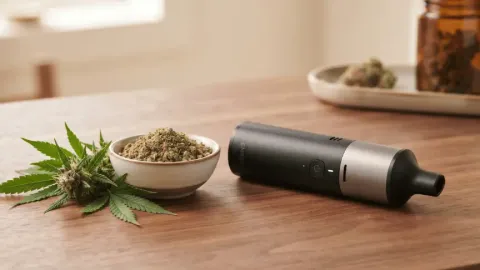
A vaporizer heats hemp flowers without burning them. Instead of smoke it produces a vapour that contains cannabinoids such as CBD and the aromatic terpenes of the flower. Anyone looking for a dry herb vaporizer for CBD flowers quickly faces plenty of questions: conduction or convection, portable or desktop, which temperature, which herbs? This guide explains the technology, the right vaporizer temperature and the criteria that matter when buying.
The key points. A dry herb vaporizer heats the flower to around 160 to 220 °C, below the temperature at which plant material burns. Convection devices heat with hot air and are considered more precise, while conduction devices heat through the chamber wall and are usually cheaper. Low temperatures bring out the aroma, higher ones release more compounds. When buying, what counts most is precise temperature control, an air path made of glass, ceramic or stainless steel, and easy cleaning.
Vaporizers for CBD flowers and cannabis: how a dry herb vaporizer works, which types exist and which temperature to choose
At its core, a vaporizer consists of a heat source, a chamber for the plant material and an air path with a mouthpiece. The flower is heated in a controlled way until cannabinoids and terpenes turn into vapour, while the plant material itself does not burn. After a session, a dry, brownish flower remains in the chamber, not ash.
Heating also triggers an important change: in the fresh flower, cannabinoids are mostly present in their acid form, CBDA or THCA. Heat converts them into CBD and THC, a process called decarboxylation. A study by Swiss researchers in the journal PLOS ONE (2016) showed that electric vaporizers with temperature control carry out this conversion reliably and release the cannabinoids evenly into the vapour.
Conduction, convection or hybrid: the three heating methods
The main technical difference between vaporizers is how the heat reaches the flower:
| Method | How it works | Advantages | Drawbacks |
|---|---|---|---|
| Conduction | The flower touches the hot chamber wall and is heated by direct contact. | Fast heat-up, compact, often affordable | Uneven heating, material needs stirring, risk of hot spots |
| Convection | Hot air flows through the flower and heats it evenly. | Very even, precise temperature, rich aroma | Usually more expensive, longer heat-up, draw technique a bit more demanding |
| Hybrid | Combines a heated chamber with hot air. | Even and fast, a good compromise | Higher price, more complex technology |
For beginners, a good conduction vaporizer is often enough. If aroma and very even heating are the priority, convection or hybrid is the better choice.
Portable or desktop vaporizer?
| Criterion | Portable vaporizer | Desktop vaporizer |
|---|---|---|
| Power | Battery, often replaceable or USB-C rechargeable | Mains power |
| Size | Pocket to hand size | Stationary, for home use |
| Temperature | Fixed presets or degree-by-degree, depending on the model | Usually degree-by-degree and very stable |
| Vapour | Through the mouthpiece | Through a balloon or a hose |
| Price | Wide range, from entry-level to premium | Mostly premium |
For use on the go or in different rooms, a portable device is more practical. If you vaporize almost only at home and want maximum temperature stability, desktop devices offer the most precise technology.
The right vaporizer temperature
Temperature is the most important setting. Each compound in the flower turns into vapour at a different temperature. The boiling points below are published, among others, by BC Cannabis Stores, the government-run retailer in British Columbia, Canada. Figures vary slightly between sources, but they give a good guide:
| Compound | Type | Approx. boiling point |
|---|---|---|
| Pinene | Terpene, pine aroma | 156 °C |
| THC | Cannabinoid | 157 °C |
| CBD | Cannabinoid | 160 to 180 °C |
| Myrcene | Terpene, earthy and fruity | 166 to 168 °C |
| Limonene | Terpene, citrus aroma | 177 °C |
| CBN | Cannabinoid | 185 °C |
| Linalool | Terpene, floral | 198 °C |
| CBC | Cannabinoid | 220 °C |
This gives three temperature ranges that most users work with:
- 160 to 180 °C: light, cool vapour with lots of aroma. Ideal for getting to know a variety's terpene profile.
- 180 to 200 °C: the range many use as their standard. Denser vapour, a good balance between aroma and yield.
- 200 to 220 °C: very dense, warmer vapour, with the aroma taking a back seat. Often chosen towards the end of a session.
Above roughly 230 °C, plant material begins to burn. Smoke forms and the point of vaporizing is lost. A good approach is to start at a low temperature and raise it in small steps during the session.
Medically certified vaporizers
In Germany, prescription cannabis flowers have been dispensed by pharmacies since 2017, and vaporizing is often recommended for their use. Some devices are certified as medical devices for this purpose. The German manufacturer Storz & Bickel, based in Tuttlingen, announced in 2023 that its Volcano Medic 2 and Mighty+ Medic models had been certified under the new EU Medical Device Regulation (MDR). Medical devices must meet stricter requirements than consumer models for materials, temperature accuracy and documentation.
The PLOS ONE study mentioned above also concluded that gas-powered vaporizers cannot be recommended for therapeutic purposes, because they hold the temperature less reliably. For patients, what matters most is electronic, degree-by-degree temperature control. The choice of device should be discussed with a doctor or pharmacist.
Which vaporizer is best? The key criteria
There is no single best vaporizer, only the best device for your needs. These are the points worth checking before you buy:
- Temperature control: degree-by-degree setting is more precise than three or four fixed presets.
- Heating method: convection or hybrid for even heating, conduction for a smaller budget.
- Air path: a mouthpiece and air path made of glass, ceramic, zirconia or stainless steel do not affect the taste. Avoid cheap plastics in hot areas.
- Heat-up time and battery: important for portable devices. A replaceable battery extends the device's life.
- Chamber size: small chambers for short sessions, larger ones for several people or longer use.
- Cleaning and spare parts: parts that come apart, and screens and seals that are available to buy.
- Warranty and markings: CE marking, a manufacturer's warranty and, for patients, certification as a medical device.
On Big CBD Product you can compare vaporizers, accessories and CBD flowers from different brands and shops.
Herbs to vaporize
A dry herb vaporizer is not limited to hemp. Many users also vaporize dried herbs for their aroma, such as lavender, chamomile, peppermint, sage, thyme or hops. Use only properly dried, untreated herbs, for example organic ones, and follow the temperature guidance from the device manufacturer. Herbs can also be mixed with CBD flowers to vary the aroma.
How to use a vaporizer, step by step
- Grind the flower: use a grinder for a medium grind. Too coarse vaporizes unevenly, too fine can clog the screens.
- Fill the chamber: pack it fairly firmly for conduction so the flower touches the wall, and loosely for convection so the air can flow through.
- Choose the temperature: start at about 170 to 180 °C and let the device heat up fully.
- Draw slowly and steadily: vaporizers need calm, long draws, especially convection devices.
- Raise it step by step: increase the temperature in steps of 5 to 10 degrees during the session.
- Empty the chamber: remove the brown, already vaporized flower and give the chamber a quick brush.
Cleaning and maintenance
Over time, resin builds up in the mouthpiece, the air path and on the screens. It spoils the taste and makes drawing harder. After each session, clean the chamber with a small brush. Regularly soak removable parts such as the mouthpiece, screens and glass parts in isopropyl alcohol, rinse them and let them dry completely before putting them back. The heating element and electronics must never come into contact with liquid. Replace worn screens and seals.
Common mistakes when vaporizing
- Too high a temperature from the start: the aroma is lost and the vapour becomes hot and harsh.
- Drawing too fast: the air has no time to heat up, so very little vapour forms.
- A badly filled chamber: too loose for conduction, too tight for convection.
- Flowers that are too moist: they vaporize poorly. Store them properly, at about 55 to 62 % humidity.
- Not cleaning: clogged screens and a bitter taste are the result.
Vaporizers are freely sold accessories and do not change the legal status of the flowers. The rules for CBD flowers differ from country to country. In the European Union, only approved hemp varieties with a maximum of 0.3 % THC may be grown, but each country decides whether and how their flowers may be sold.
Frequently asked questions about vaporizers
What is the right vaporizer temperature?
Most users work between 160 and 220 °C. 160 to 180 °C brings out the aroma, 180 to 200 °C is the standard range and 200 to 220 °C gives very dense vapour. Above roughly 230 °C the flower starts to burn.
Which is better, conduction or convection?
Convection heats the flower with hot air more evenly and precisely, but is usually more expensive. Conduction heats through the chamber wall, heats up faster and costs less. Hybrid devices combine both methods.
Which vaporizer is best?
It depends on your needs. What matters is degree-by-degree temperature control, an air path made of glass, ceramic or stainless steel, a suitable chamber size, a good battery for portable devices and available spare parts.
How fine should flowers be ground for a vaporizer?
Medium, ideally with a grinder. A grind that is too coarse vaporizes unevenly, one that is too fine can clog the screens.
Which herbs can you vaporize?
Besides hemp flowers, lavender, chamomile, peppermint, sage, thyme and hops are often vaporized for their aroma. Use only properly dried, untreated herbs and follow the manufacturer's guidance.
How do you clean a vaporizer?
Brush out the chamber after every session. Regularly soak removable parts such as the mouthpiece, screens and glass parts in isopropyl alcohol, rinse them and let them dry completely. The heating element and electronics must never touch liquid.