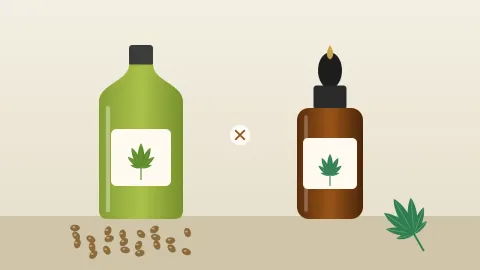
Many bottles sold as "hemp oil" actually contain a culinary or cosmetic oil pressed from hemp seeds. CBD oil, by contrast, is made by dissolving cannabidiol extracted from the plant's flowers and leaves in a carrier oil. Both come from the same plant, but their content, price and legal status are completely different. This article explains the difference, how to read the label and how to compare prices correctly.
In short. Hemp seed oil is cold-pressed from the seeds, is rich in polyunsaturated fatty acids and contains no CBD or only traces. CBD oil contains a defined amount of CBD, stated on the label in milligrams or as a percentage. If the label says "Cannabis Sativa Seed Oil", it is seed oil. If it says "Cannabidiol" or "Cannabis Sativa Leaf Extract", it contains an extract.
Are hemp oil and CBD oil the same? Two different oils from seed and flower
No. The difference lies in which part of the plant is used. Cannabinoids such as CBD and THC are formed in the flowers and leaves, in tiny resin glands called trichomes (see cannabis trichomes). Seeds have no such glands. That is why oil pressed from the seeds is practically free of cannabinoids. To make CBD oil, an extract is taken from flowers and leaves and mixed into a carrier oil.
What is hemp seed oil?
Hemp seed oil is obtained by cold-pressing the seeds. It is greenish in colour and tastes nutty. Most of it consists of polyunsaturated fatty acids, mainly linoleic acid and alpha-linolenic acid. It does not tolerate heat well, so it is usually used cold: in salad dressings, smoothies or skin and hair care products.
- CBD: none, or only traces from plant material that sticks to the seed husk during pressing. No CBD content is stated on the label.
- THC: since 2023, the EU has set a legal maximum for THC in hemp seed oil sold as food: 7.5 mg per kilogram (sum of Δ9-THC and THCA). For the seeds themselves, the limit is 3.0 mg per kilogram.
- Price: sold in large bottles of 250 ml to one litre, at prices close to other cold-pressed oils.
We cover the nutritional values of the seeds in our hemp seeds article.
What is CBD oil?
CBD oil is made by dissolving an extract from the hemp plant's flowers and leaves in a carrier oil. The carrier is usually MCT oil (from coconut), olive oil or hemp seed oil. So a CBD oil may contain hemp seed oil, but not the other way round.
Depending on the extract, there are three types of CBD oil:
- Full spectrum: contains CBD plus the plant's other cannabinoids, terpenes and THC below the legal limit.
- Broad spectrum: contains other cannabinoids, but the THC has been removed.
- Isolate: contains purified CBD only.
These products are usually sold in 10 ml dropper bottles and priced according to the amount of CBD they contain.
Comparison table
| Criterion | Hemp seed oil | CBD oil |
|---|---|---|
| Source | Seeds, cold-pressed | Flower and leaf extract + carrier oil |
| CBD | None or traces | Amount stated on the label (e.g. 1,000 mg in 10 ml) |
| THC | Traces, legal limit for food in the EU | Varies by product, shown in the lab report |
| Typical packaging | 250 ml to 1 litre bottle | 10 ml or 30 ml dropper bottle |
| INCI name (cosmetics) | Cannabis Sativa Seed Oil | Cannabidiol, Cannabis Sativa Leaf Extract |
| EU status | Permitted as food | Not authorised as food, possible as cosmetic |
How to tell them apart on the label
- Check the ingredients list. Cosmetics list ingredients by their international INCI names. "Cannabis Sativa Seed Oil" is seed oil. "Cannabidiol" is pure CBD. "Cannabis Sativa Leaf Extract" or "Cannabis Sativa Flower/Leaf/Stem Extract" is a plant extract.
- Look for the CBD content. A genuine CBD oil states the total CBD in the bottle in milligrams or as a percentage. Phrases such as "1,000 mg hemp" that do not mention CBD usually refer to seed oil or to the amount of oil, not of extract.
- Be careful with "hemp oil". In English, "hemp oil" is used for both seed oil and CBD oil. The term alone does not tell you what the product is.
- Ask for a lab report. A serious CBD oil producer shares a certificate of analysis (COA) from an accredited laboratory, showing the CBD and THC content. We explain how to read one in how to read a CBD certificate of analysis.
- Look at the price and bottle size. A large bottle sold very cheaply is almost always seed oil. CBD extract is an expensive raw material.
How to compare prices
Comparing CBD oils by bottle price is misleading, because the CBD content can vary widely. The right measure is the price per milligram of CBD:
- A 10 ml bottle at 10% contains about 1,000 mg of CBD (10 ml × 100 mg/ml).
- If that bottle costs €40, the price per milligram is €40 / 1,000 mg = €0.04.
- If a 10 ml bottle at 5% (500 mg) costs €25, the price per milligram is €0.05. The bottle that looks cheaper is actually more expensive.
We apply the same logic to flowers and resin in compare prices per gram. For hemp seed oil, which contains no CBD, the price per litre and whether it is cold-pressed are enough.
The situation in Europe
- Hemp seed oil: permitted as food in the EU, subject to the THC limit above.
- Foods containing CBD: in the EU, CBD is considered an unauthorised novel food. CBD oil therefore cannot legally be sold as food or as a food supplement.
- CBD cosmetics: may be sold under cosmetics law. THC limits vary from country to country.
On Big CBD Product you can compare CBD cosmetics across brands and sellers: CBD cosmetics.
The situation in Turkey
The Turkish "Regulation on Products Obtained from Cannabis", published on 31 January 2026, set up a new system for products containing cannabinoids. They are licensed or notified as medicinal, health, support or personal care products and may only be sold in pharmacies. Support and personal care products may contain at most 0.3% THC. See our article on medical cannabis in Turkey. Hemp seed oil has long been sold in Turkey as food and cosmetics, and we found no explicit provision on how it is treated under the new system.
Sources
- Tentamus, "Change of THC maximum levels in hemp seeds and hemp seed oil" (tentamus.com), accessed 9 November 2026
- European Food Safety Authority (EFSA), "Cannabidiol novel food evaluations on hold pending new data" (efsa.europa.eu)
- European Commission, CosIng cosmetic ingredients database (ec.europa.eu)
- Regulation on Products Obtained from Cannabis, Turkish Official Gazette 31 January 2026, No. 33154 (resmigazete.gov.tr)
FAQ · 5 questions
Frequently asked questions about hemp seed oil and CBD oil
Short, clear answers with no health claims.
Does hemp seed oil contain CBD?
Hemp seed oil contains no CBD or only traces. CBD forms in the resin glands of the flowers and leaves, not in the seeds. If the label states no CBD content, the product is most likely seed oil.
Can hemp seed oil get you high?
No. Hemp seed oil does not contain enough THC to have a psychoactive effect. In the EU there is also a legal maximum for THC in seed oil sold as food.
What does 10% CBD oil mean?
It means each millilitre of oil contains about 100 mg of CBD. A 10 ml bottle at 10% contains about 1,000 mg of CBD in total.
If the label says "hemp oil", which one is it?
The term alone is not enough, because it is used for both seed oil and CBD oil. Check the ingredients and the CBD content: "Cannabis Sativa Seed Oil" is seed oil, "Cannabidiol" is CBD.
Can CBD oil be sold as a food supplement in the EU?
No. CBD is considered an unauthorised novel food in the EU, so CBD oil cannot legally be marketed as food or as a food supplement. CBD cosmetics may be sold under cosmetics law.
This article is for general information only and does not replace medical or legal advice. Information as of 9 November 2026.
Big CBD Product is an independent, non-profit comparison site. Our answers follow a public method: verified data, dated reviews and no disguised advertising. See our method