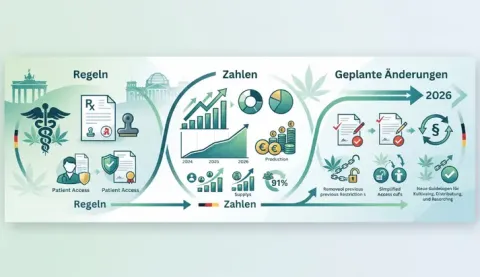
Since 1 April 2024, medical cannabis has no longer been classed as a narcotic in Germany. Doctors now prescribe it on a standard prescription, and demand has risen sharply. The federal government now wants to tighten the rules again: first prescriptions only after an in-person consultation, and an end to postal delivery of cannabis flowers. This overview explains what applies today, what is planned and what would change for patients.
The key points. In Germany, medical cannabis is prescription-only and dispensed by pharmacies. It is governed by the Medical Cannabis Act (Medizinal-Cannabisgesetz, MedCanG). A federal government bill (Bundestag document 21/3061) provides that cannabis flowers could only be prescribed for the first time after an in-person consultation, and could no longer be sent by post. As of mid-September 2026, the bill has not yet been passed: until it comes into force, the current rules continue to apply.
Medical cannabis in Germany: the legal framework
The history of medical cannabis in Germany can be summed up in two stages. From March 2017, the "Cannabis als Medizin" law (cannabis as medicine) allowed cannabis flowers and extracts to be prescribed at the expense of statutory health insurance, at that time still on a narcotics prescription. With the Cannabis Act of 1 April 2024, cannabis for medical use was taken out of the Narcotics Act (Betäubungsmittelgesetz) and placed under its own law, the Medizinal-Cannabisgesetz.
Since then, the essentials are as follows:
- Medical cannabis remains prescription-only and is dispensed only by pharmacies.
- A standard prescription is enough, a narcotics prescription is no longer needed.
- Statutory health insurers only cover the costs under certain conditions, and usually after prior approval.
- Patients treated outside insurance cover receive a private prescription and pay for their treatment themselves.
What is medical cannabis prescribed for?
There is no exhaustive list of conditions for which cannabis may be prescribed. The decision lies with the treating doctor. For the costs to be covered by statutory health insurance, there generally has to be a serious illness for which no recognised standard treatment is available or can be used.
The accompanying survey by the Federal Institute for Drugs and Medical Devices (BfArM), which collected data on insurer-funded cannabis treatments between 2017 and 2022, paints a clear picture: in around three quarters of the cases analysed, pain was the main reason for the prescription. Other frequently cited areas included spasticity, for example in multiple sclerosis, as well as loss of appetite and weight loss in serious illnesses.
Important: medical cannabis is not a miracle cure and is not suitable for everyone. It is the treating doctor, and the doctor alone, who decides whether treatment makes sense, which form is suitable and what dosage to use.
Flowers, extracts, finished medicines: the available forms
In Germany, medical cannabis is prescribed in three main forms:
- Cannabis flowers: dried flowers with a defined THC and CBD content, dispensed by pharmacies. They are generally used with a medical vaporizer.
- Cannabis extracts: standardised extracts, often as an oily solution taken by mouth.
- Finished medicines: authorised medicinal products containing cannabinoids, for specific indications.
The planned reform mainly concerns flowers. Extracts and finished medicines are not covered by the new rules on first prescriptions and postal delivery.
Strong growth: the figures behind the debate
Since April 2024, the medical cannabis market in Germany has grown strongly. According to the Federal Ministry of Health, around 80 tonnes of cannabis flowers were imported in the first half of 2025, compared with around 19 tonnes in the same period of the previous year. For 2025 as a whole, BfArM data show imports of around 201 tonnes, mainly from Canada and Portugal. Part of the demand is also met by cultivation in Germany under state control.
Over the same period, prescriptions covered by statutory health insurance rose by only a few per cent, according to the ministry. The government concludes that a large part of the increase comes from private prescriptions, often issued via online platforms offering telemedicine consultations. This is exactly where the bill comes in.
The planned amendment to the Medical Cannabis Act
On 8 October 2025, the Federal Cabinet adopted a bill amending the MedCanG. Under this bill, two main changes are planned:
- In-person consultation for the first prescription: cannabis flowers could only be prescribed for the first time after a consultation at the practice or during a home visit. For repeat prescriptions, an in-person consultation would have to take place at least once every four quarters.
- End of postal delivery of flowers: online pharmacies would no longer be allowed to ship flowers. Delivery by courier from a local pharmacy would remain possible.
According to the government, the aim is to curb abuses, such as prescriptions issued on the basis of a simple online questionnaire without a proper medical examination. Critics, including patient associations and part of the medical profession, warn instead of gaps in access to care, particularly for people with chronic illnesses or those living in rural areas, who rely on telemedicine and postal delivery.
Where does the legislative process stand?
The bill's path through parliament:
| Date | Stage |
|---|---|
| July 2025 | Draft bill from the Federal Ministry of Health |
| 8 October 2025 | Adopted by the Federal Cabinet |
| 21 November 2025 | Bundesrat opinion at first reading |
| December 2025 | Submitted to the Bundestag (document 21/3061), first reading on 18 December |
| 14 January 2026 | Public hearing in the Health Committee |
| February 2026 | Petition against the bill, backed by around 58,000 people, examined by the Petitions Committee |
| Mid-September 2026 | Second and third readings in the Bundestag not yet held |
There are disagreements within the governing coalition, particularly over the general ban on postal delivery. Changes to the bill therefore remain possible. After the Bundestag vote, the Bundesrat will have to consider the law again. Under the bill, it would come into force on the day after its promulgation, with no transition period for ongoing treatments.
What does this mean for patients?
Until the law is passed and promulgated, the current rules remain in force. People already being treated with medical cannabis, or considering treatment, would nevertheless do well to prepare:
- Arrange medical follow-up: patients seen only via telemedicine should find a practice for an in-person consultation in good time.
- Plan for a local pharmacy: if postal delivery of flowers is banned, collection from a pharmacy or delivery by the local pharmacy would become the way to obtain supplies.
- Discuss alternatives: extracts and finished medicines are not affected by the planned restrictions. It is up to the treating doctor to judge whether a switch makes medical sense.
- Check insurance cover: with approval from the health insurer, treatment is generally independent of private prescription platforms.
Medical cannabis, recreational cannabis and CBD: three different things
Public debate often mixes up three areas that are legally quite separate:
- Medical cannabis: prescription-only, available only on prescription from pharmacies, governed by the Medizinal-Cannabisgesetz.
- Recreational cannabis: legal for adults since April 2024 under strict conditions (possession, private home growing, cultivation associations), governed by the Konsumcannabisgesetz. Sale in shops is not permitted.
- CBD products from industrial hemp: products made from hemp varieties with a very low THC content, such as cosmetics or aromatic products. They are not medicines, may not be promoted with therapeutic claims and do not replace medical treatment.
On Big CBD Product, we compare only CBD and hemp products. Medical cannabis is a matter for doctors and pharmacies.
FAQ · 6 questions
Frequently asked questions about medical cannabis in Germany
Short, clear answers with no health claims.
Is medical cannabis legal in Germany?
Yes. Medical cannabis is prescription-only and dispensed on prescription by pharmacies. Since 1 April 2024, it has no longer been classed as a narcotic and is governed by the Medical Cannabis Act (MedCanG).
Do you need a narcotics prescription for medical cannabis?
No. Since April 2024, a standard prescription is enough. Statutory health insurers only cover the costs under certain conditions, usually after prior approval.
Will postal delivery of cannabis flowers be banned?
The federal government's bill (document 21/3061) plans to ban the shipping of cannabis flowers; delivery by a local pharmacy would remain allowed. As of mid-September 2026, the bill has not yet been passed.
Can you still get medical cannabis through telemedicine?
Under current law, yes. Under the bill, a first prescription for flowers would in future require an in-person consultation, at the practice or at home. Extracts and finished medicines are not affected.
When will the new rules apply?
No date has been set. The law must be passed by the Bundestag and then go back to the Bundesrat. Under the bill, it would come into force on the day after its promulgation, with no transition period.
Is CBD the same as medical cannabis?
No. CBD products from industrial hemp with a very low THC content are not medicines and may not be promoted with therapeutic claims. Medical cannabis is a prescription-only medicine dispensed by pharmacies.
This article is for general information only and does not replace medical or legal advice. Information as of mid-September 2026. Legislative processes can change quickly.
Big CBD Product is an independent, non-profit comparison site. Our answers follow a public method: verified data, dated reviews and no disguised advertising. See our method